

The Default Setting: women, AI and the choices facing UK manufacturing
Author: Zoi Roupakia
Correspondence: zoi.roupakia@noeticai.co
Women make up 27.8% of the UK manufacturing workforce but 63.4% of employment in the occupations most exposed to generative AI. In our survey of 890 manufacturing professionals, women are more concerned than men that AI bias affects wellbeing, pay and job opportunities, diversity and inclusion, and productivity. Our new report, The Default Setting: Women, AI, and the Future of Work in UK Manufacturing, commissioned by Beko UK and Ireland, looks at what this means for women's careers in the sector, and what manufacturers and policymakers can do while adoption is still at an early stage.
Download the report The Default Setting: Women, AI, and the Future of Work in UK Manufacturing.
UK manufacturing is pursuing two ambitions at the same time: accelerating the adoption of artificial intelligence across the sector, through the AI Adoption Plan for Advanced Manufacturing, and increasing women's participation in advanced manufacturing to 35% by 2035, through the Advanced Manufacturing Sector Plan. Whether those ambitions reinforce each other will depend on more than the capabilities of the technology. It will depend on where AI is introduced, whose work changes first, who has access to new tools and skills, and how organisations govern systems that increasingly shape decisions about work and careers.
The Default Setting looks at this question using three sources of evidence: an analysis of occupational exposure to generative AI, combining International Labour Organization (ILO) exposure data with Office for National Statistics (ONS) employment data; an original Noetic AI survey of 890 UK manufacturing professionals; and a review of international research on AI, gender, and work.
The starting point
The sector enters the AI transition from an unequal baseline. In 2025, women were 27.8% of manufacturing employment and 27.3% of managers, directors and senior officials. The median hourly gender pay gap in manufacturing was 14.7%. AI is not entering a neutral labour market. AI did not cause these figures, but they are the default setting that AI adoption will either carry forward or help change.
Exposure follows occupational segregation
Manufacturing as a whole is less exposed to generative AI than the wider economy. That average hides a large gender difference. An estimated 41.1% of women's manufacturing employment is in occupations with some exposure to generative AI, compared with 23.6% of men's. At the highest exposure level, the figures are 12.5% and 2.8%.
The reason is where women and men work. Administrative roles are around two-thirds women, and more than 85% of these jobs sit in the two highest exposure categories. Skilled trades and machine operative roles, which are mostly held by men, contain no occupations in those categories. As a result, women's share rises from 27.8% of the workforce to 63.4% of employment in the highest-exposure occupations.
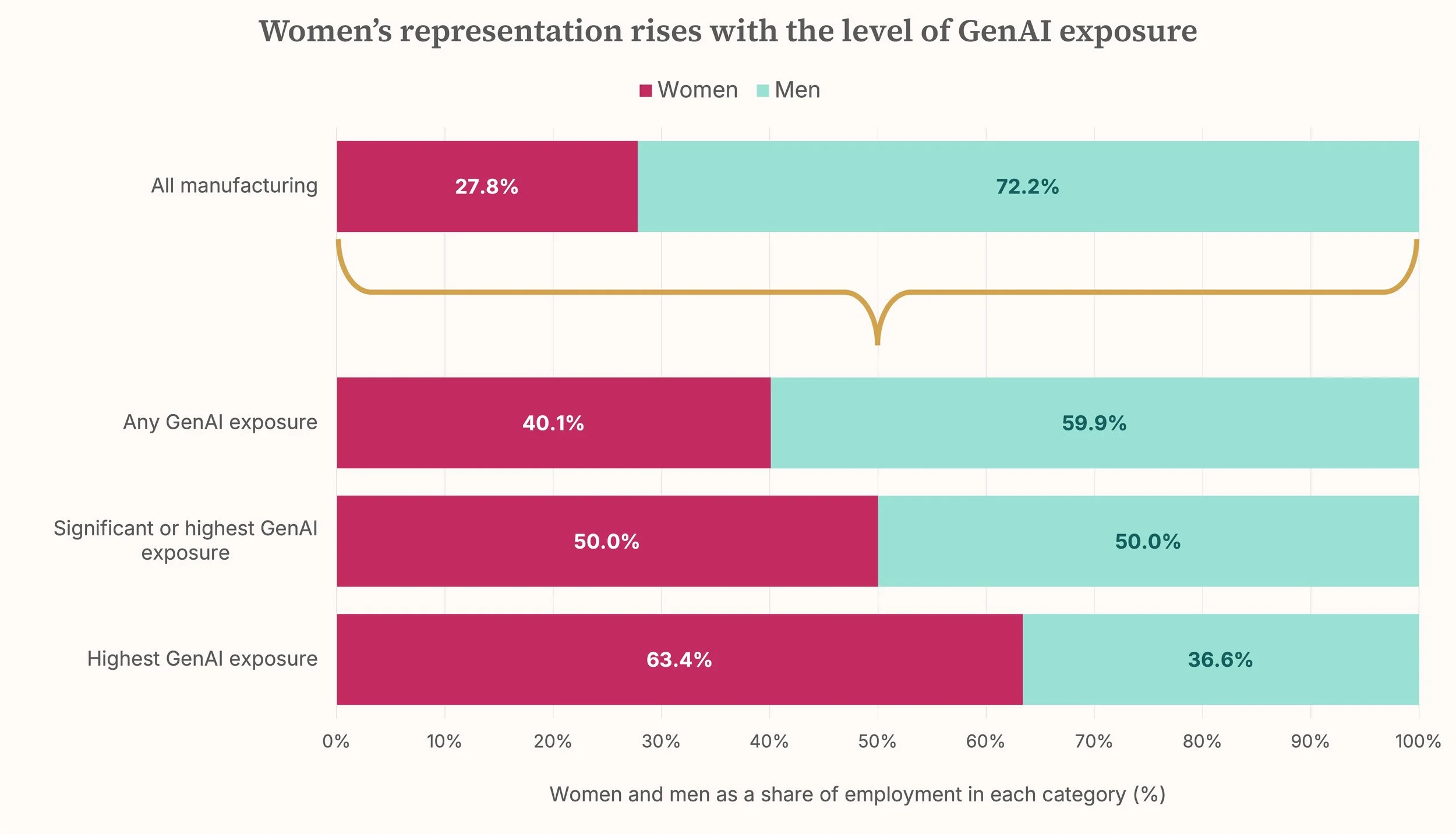
Figure 1: Women's share of UK manufacturing employment, by level of GenAI exposure
Note: “Any GenAI exposure” includes occupations classified by the ILO as having low, moderate, significant, or highest GenAI exposure. Women and men total 100% within each row. The first row shows the baseline composition of UK manufacturing employment; the three rows below progressively restrict the population to GenAI-exposed occupations.
Source: Author’s analysis of ONS Annual Population Survey four-digit SOC2020 occupation by four-digit SIC 2007 industry data, April 2025–March 2026, scaled within SOC major groups to ONS Annual Population Survey workplace analysis T10c via Nomis, January–December 2025, UK manufacturing (SIC 2007 Section C), by SOC2020 major group and sex; ONS SOC2020 coding index (December 2025); and ILO exposure classifications from Gmyrek, P. et al. (2025). Generative AI and Jobs: A Refined Global Index of Occupational Exposure, ILO Working Paper, 140, Annex Table A1.
Exposure is not a forecast of job loss. It identifies where current GenAI tools could perform or assist a substantial share of tasks, and so where adoption decisions will be felt first. This matters because current AI use in manufacturing, according to Make UK, is concentrated in back-office functions such as HR, finance and administration: 83% of manufacturers using AI apply it there. What happens next depends on organisational choices: whether technology augments people or substitutes for tasks, whether roles are redesigned, whether workers receive training, and whether new opportunities are distributed broadly.
Similar use of AI, different concerns about its consequences
Women and men in the survey use AI at similar rates, report similar expertise, and report similar experience of AI bias (24.7% of women and 22.0% of men). The difference appears when respondents consider its effects.
Women surveyed are more likely than men to believe AI bias negatively affects employee wellbeing (41.1% vs 28.7%), pay or job opportunities (33.3% vs 22.9%), and diversity and inclusion (27.7% vs 17.1%). Women are also more likely to see effects on business performance: around 55% of women, compared with 45% of men, see at least some negative effect of AI bias on productivity, and 27.1% compared with 20.2% on competitiveness. These differences hold after accounting for role, company size, age, and AI use and expertise.
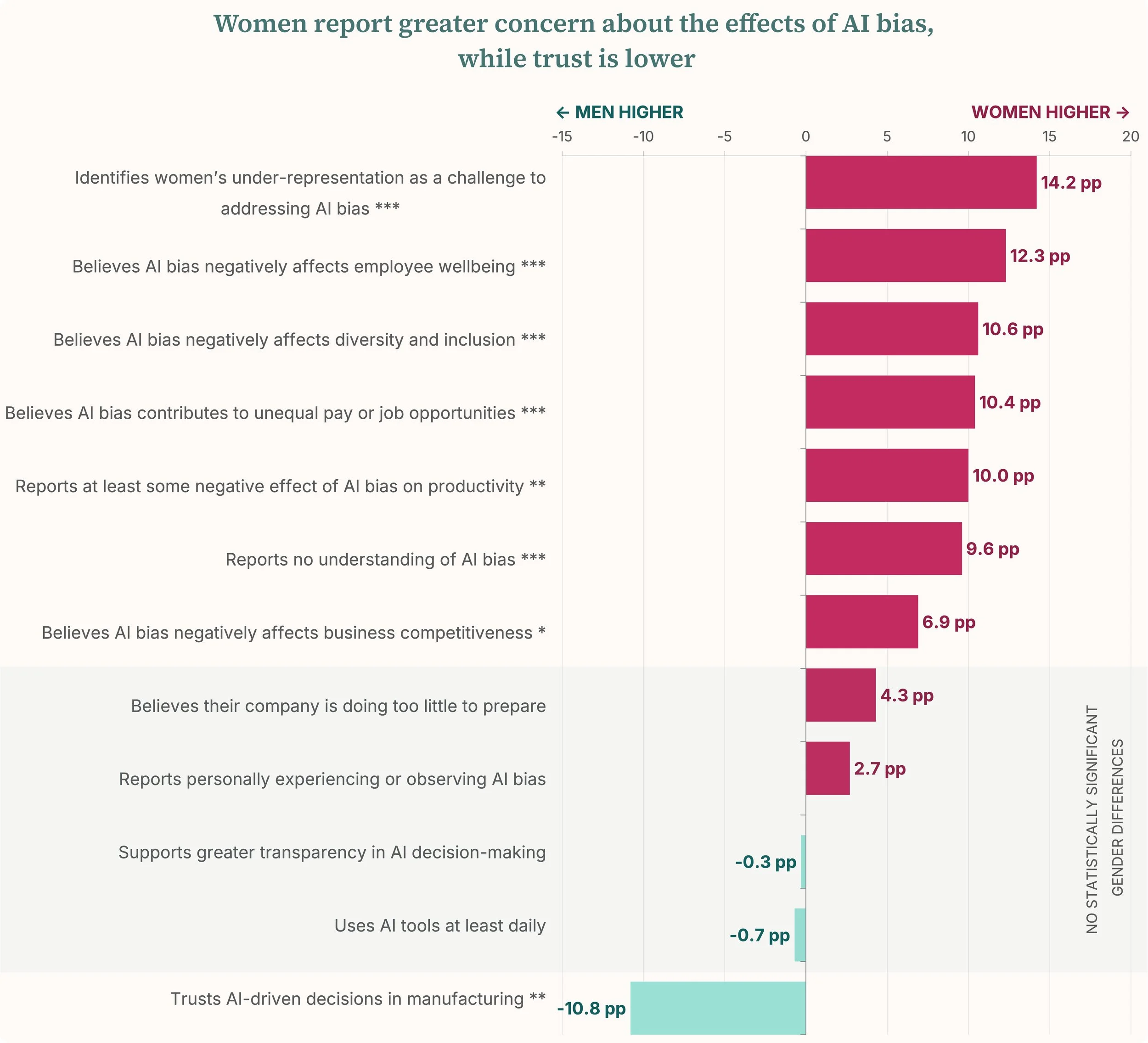
Figure 2: Selected gender differences in perceptions of AI bias across key indicators
Note: Based on up to 886 respondents (550 men and 336 women). Bars show the percentage point difference between women and men in the proportion selecting the specified response or combined response categories. Positive values indicate a higher proportion among women; negative values indicate a higher proportion among men. The representation item was part of a multiple-response question. Statistical significance is based on chi-square tests with Yates’ correction: * p < 0.05, ** p < 0.01, *** p < 0.001. Items without stars show no statistically significant gender difference.
Source: Roupakia, Z. (2026). AI Bias in Manufacturing: A UK Workforce Survey. Noetic AI.
Concern about AI and unequal pay is already high among the youngest women. Among women aged 22 to 29, 34.9% are concerned, close to the 39.0% of women aged 50 to 59, even though the sector pay gap for the younger group is 7.6% compared with 20.0%. For a sector trying to reach 35% women by 2035, how these expectations are met may affect retention as much as recruitment.
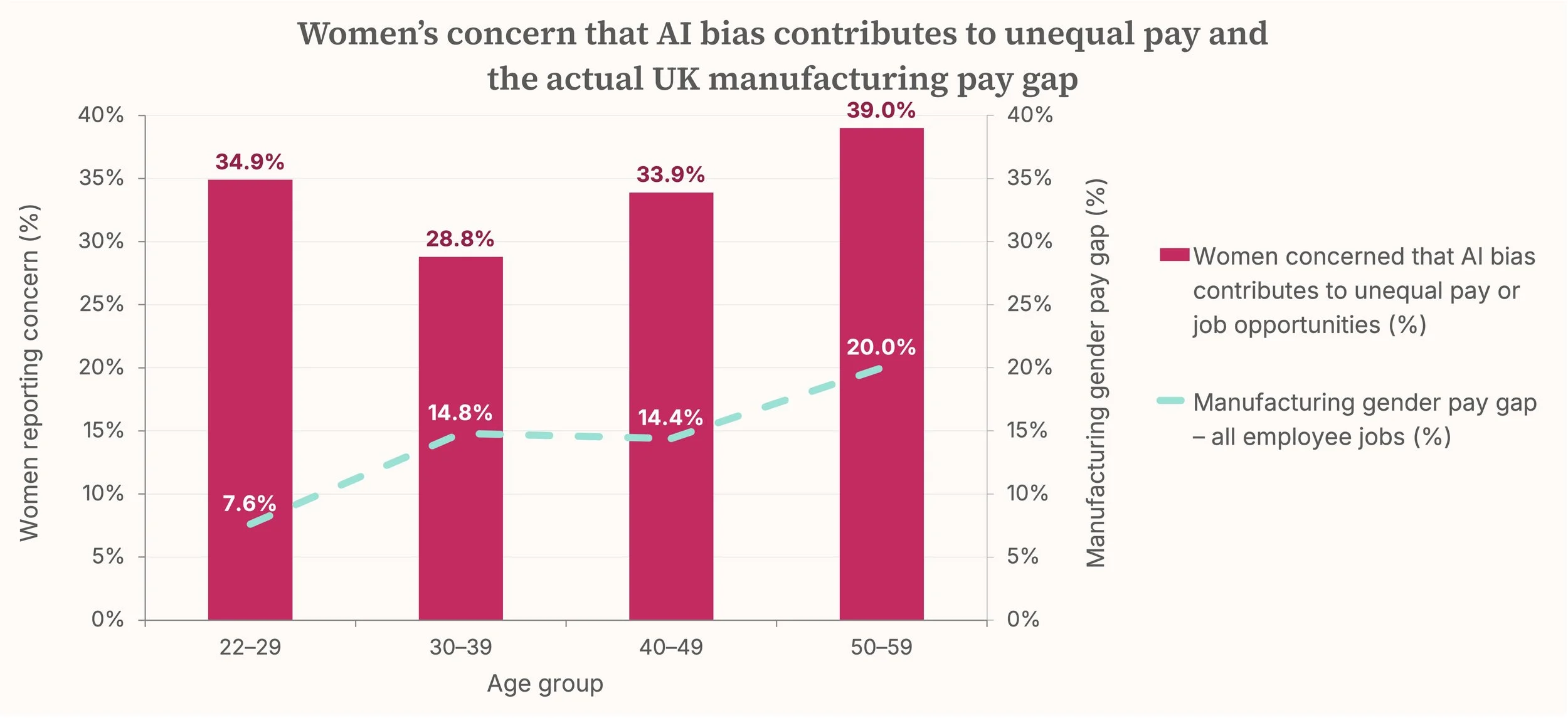
Figure 3: Women’s concern about AI-bias-related pay inequality and the manufacturing gender pay gap, by age group
Note: Based on 302 women respondents aged 22–59 with valid age data. The left axis (bars) shows the percentage of women who responded “Probably yes” and “Definitely yes” to the question, “Do you believe AI bias contributes to unequal pay or job opportunities in UK manufacturing?” The 18–21 and 60+ age groups are excluded because of the small sample sizes. Differences in concern between age groups are not statistically significant. The right axis (line) shows the median manufacturing gender pay gap.
Source: Roupakia, Z. (2026). AI Bias in Manufacturing: A UK Workforce Survey. Noetic AI; ONS (2025). Annual Survey of Hours and Earnings, Table 21.12, Manufacturing (SIC C), all employee jobs, median gender pay gap by age group, 2025 provisional.
Trust and fairness need different responses
Women are less likely than men to trust AI-driven decisions (32.1% vs 42.9%). Trust is similar among the youngest respondents, and the gap is widest among those aged 40 to 49.
Where respondents think their company is preparing well for AI bias, trust is higher for both women and men. Concern about pay and job opportunities, however, stays at the same level. Preparedness builds confidence in AI, but it does not on its own answer concerns about fairness. Organisations need to address both.
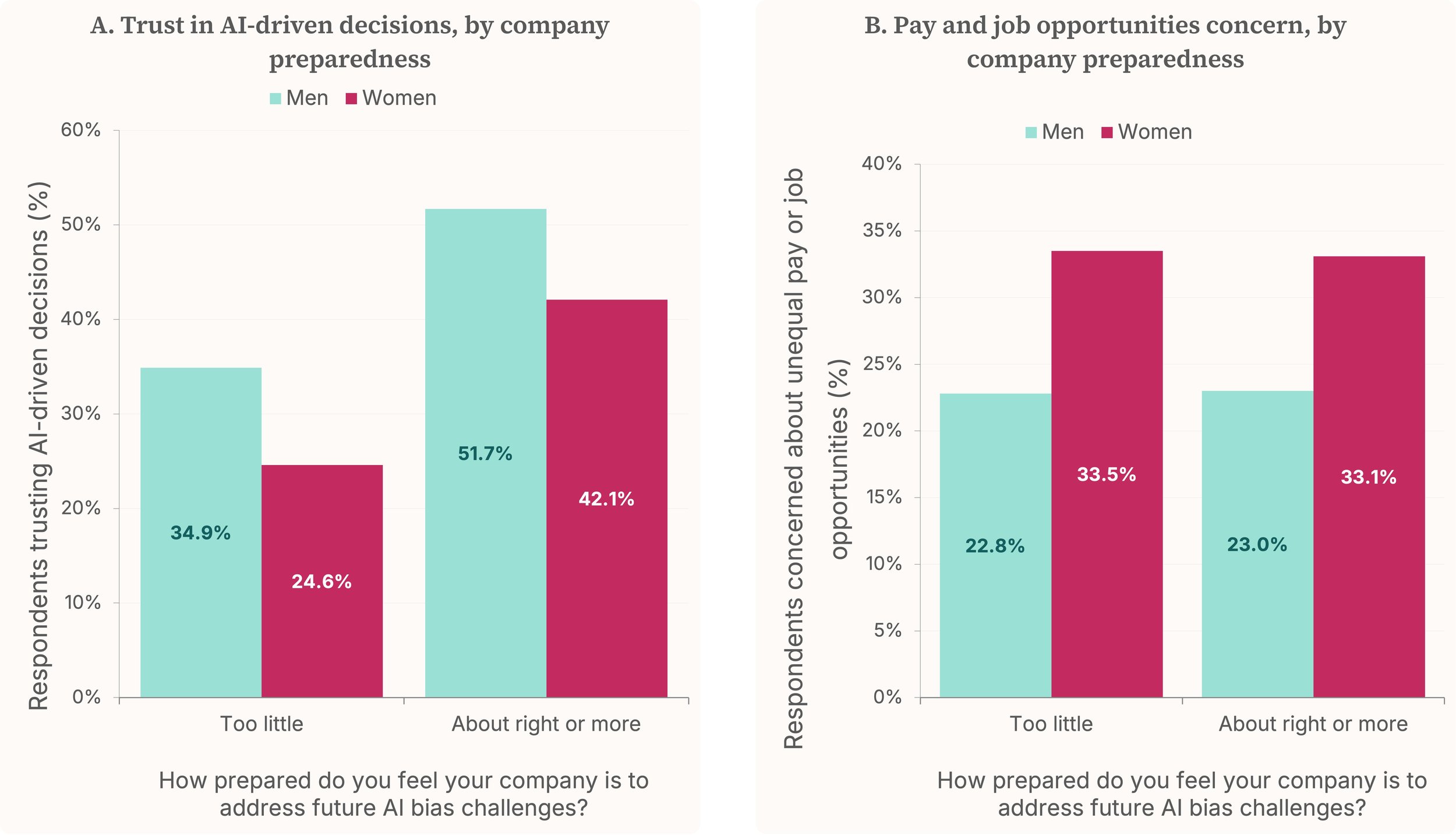
Figure 4: Trust in AI-driven decisions and concerns about pay and job opportunities, by gender and perceived company preparedness
Note: Based on 886 respondents (550 men, 336 women). Panel A: respondents answering "Probably yes" or "Definitely yes" to "Do you trust AI-driven decisions in manufacturing?". Panel B: respondents answering "Probably yes" or "Definitely yes" to "Do you think AI bias contributes to unequal pay or job opportunities?". "Too little" combines "Far too little" and "Slightly too little". "About right or more" combines "Neither too much nor too little," "Slightly too much", and "Far too much". Preparedness is positively associated with trust (r = 0.27, *** p < 0.001) but not with concern about pay and job opportunities (r = 0.02, not significant). Subgroup sizes: Too little: 289 men, 191 women; About right or more: 261 men, 145 women.
Source: Roupakia, Z. (2026). AI Bias in Manufacturing: A UK Workforce Survey. Noetic AI.
There is also a gap in visibility: 58% of respondents are not aware of any measures their company is taking on AI bias. At the same time, around 87% of both women and men want AI systems to be more transparent. That shared view is a practical starting point.
Hiring is where bias is most often seen
Recruitment is the area where respondents most often report observing AI bias. The international evidence points the same way: audits of large language models have found some favour men in callback decisions, and some recommend lower pay for equally qualified women. Because results vary between tools, testing in the employer's own context is more useful than relying on any single published audit.
Resetting the default: five areas of action for inclusive AI adoption in UK manufacturing
The report sets out actions for organisations and for policymakers in five areas:
Know where AI is shaping work and workforce decisions, and govern it accordingly.
Direct training and skills support to where AI is changing work, including administrative, customer-facing and professional roles.
Test AI systems for fair treatment before and after deployment.
Involve women and affected workers in AI adoption and work redesign.
Track whether the benefits and opportunities from AI are being shared fairly.

Figure 5: Five areas of action for inclusive AI adoption in UK manufacturing
The direction of change is not predetermined
The evidence does not show that AI is taking women's jobs in manufacturing. It shows that women are concentrated in the roles most exposed to change, are more concerned about its consequences, and work in a sector where most employees cannot see what their employer is doing about AI bias.
The transition is under way. Its direction is not set by the technology. It depends on choices organisations make now about training, governance, role redesign, and who is involved in those decisions. Those choices will decide whether AI adoption widens access to skills, fair treatment, participation and progression, or reproduces existing inequalities in the structure of work.
Cite as: Roupakia, Z. (2026). The Default Setting: Women, AI, and the Future of Work in UK Manufacturing. Noetic AI. DOI: 10.5281/zenodo.22936822.
This report was commissioned by Beko UK and Ireland and prepared independently by Noetic AI.
Related: Beko UK and Ireland’s announcement of the commissioned research.